Industrial facilities in the UAE operate under conditions that test every engineering decision you make. Ambient temperatures exceed 48°C in summer. Process environments push pipe and vessel surfaces far beyond what unprotected materials can sustain. Energy costs are a real operational pressure. And in sectors like oil and gas, petrochemicals, power generation, and marine, a failure in your insulation system is not just an efficiency problem. It is a safety one.
Insulation and cladding are not finishing details. They are core engineering decisions that affect heat conservation, personnel protection, asset longevity, regulatory compliance, and energy performance across every facility they are applied to. With dozens of insulation and cladding companies in Dubai operating across the industrial, oil and gas, and commercial sectors, knowing how to evaluate your options is half the battle.
This guide covers everything you need to know: what insulation and cladding actually do, the materials used, the sectors they serve, how to select the right system for your application, and what to look for when choosing a contractor.
What Is Industrial Insulation?
Industrial insulation is the application of thermally resistant materials to pipes, vessels, equipment, and building envelopes to control heat transfer. Depending on the application, the objective may be to retain heat, prevent heat gain, protect personnel from hot surfaces, reduce condensation, control noise, or prevent freezing.
The basic principle is the same across all applications: a layer of thermally resistant material, held in place and protected by a cladding jacket, reduces the rate at which heat moves between the insulated surface and its surroundings. How much it reduces that rate depends on the material selected, its thickness, its installation quality, and the cladding that protects it.
In the UAE's industrial environment, insulation is not optional. It is a functional requirement for safe, efficient, and compliant operations.
What Is Cladding?
Cladding is the protective outer layer applied over insulation material. Its primary purpose is to protect the insulation from mechanical damage, moisture ingress, UV degradation, and the physical stresses of the operating environment.
Cladding also serves a secondary aesthetic function in commercial and architectural applications, but in industrial settings, its role is entirely functional. The cladding material must be compatible with the operating environment, resistant to corrosion, and mechanically robust enough to survive the conditions it will face.
Common cladding materials include:
| Material |
Application |
| Aluminium |
General industrial pipework, vessels, commercial applications |
| Stainless steel |
Refineries, offshore rigs, high-corrosion environments |
| Galvanised iron (GI) |
Ductwork, commercial HVAC, lower-cost applications |
| Alloy metals |
Specialist high-temperature or high-corrosion applications |
Lijan Group works with all types of jacketing material including aluminium, alloy metal, and stainless steel, using locally and internationally certified materials across industrial and marine applications.
Types of Insulation: A Complete Overview
1. Hot Insulation
Hot insulation is applied to surfaces that operate at temperatures above ambient. The objective is to retain heat within the system, reduce energy loss, and protect personnel from contact with hot surfaces.
Applications include:
- Boilers and associated pipework
- Chemical reactors
- Engine exhaust pipes on oil rigs
- Refineries and petrochemical plants
- Power and desalination plants
- Oil and gas upstream applications, both offshore and onshore
Lijan Group specialises in executing hot insulation and jacketing for a wide range of industrial applications, including fire-rated A60 insulation for bulkheads and deckheads on jack-up rigs, engine exhaust pipes for oil rigs, chemical reactors, boilers and associated pipes, refineries and petrochemical plants, and power and desalination plants.
2. Cold Insulation
Cold insulation is applied to systems operating below ambient temperature. The challenge here is not heat loss but heat gain: preventing the warmer surrounding environment from transferring heat into the cold system, and preventing condensation forming on cold surfaces which leads to corrosion and moisture damage.
Applications include:
- Cryogenic storage and transfer systems
- LNG pipelines
- Chilled water pipework in HVAC systems
- Refrigerated process systems
- TES (Thermal Energy Storage) tanks and data centre cooling infrastructure
Cold insulation requires vapour barriers in addition to the insulating material itself, as moisture penetration is the primary failure mechanism in below-ambient systems.
3. Refractory Insulation
Refractory insulation is designed for extreme high-temperature applications where standard thermal insulation materials would not survive. It is used in furnaces, kilns, incinerators, and other equipment operating at temperatures that can exceed 1,000°C.
4. Cryogenic Insulation
Cryogenic insulation addresses the most extreme cold applications, typically below -100°C. LNG storage, liquid nitrogen systems, and related processes fall into this category. Specialist materials and installation techniques are required.
5. Acoustic Insulation
Acoustic insulation reduces noise transmission from industrial equipment, pipework, and ductwork. In facilities where noise levels must be controlled for personnel protection or regulatory compliance, acoustic treatment of mechanical systems is a core requirement alongside thermal insulation.
6. Personal Protective Insulation
Personal protective insulation, also called personnel protection jacketing, is applied to surfaces within reach of workers where contact with the hot surface would cause injury. It is a safety requirement in any facility where pipes, vessels, or equipment operate at temperatures above safe touch limits and are located in personnel traffic areas.
Lijan Group provides personnel protective jacketing for FPSOs, refineries, and petrochemical plants, alongside oil and gas upstream applications, both offshore and onshore.
7. Fire-Rated Insulation
Fire-rated insulation, most commonly A60-rated systems, provides passive fire protection to structural elements, bulkheads, and deckheads by limiting heat transfer in the event of a fire. A60 classification means the insulation system maintains structural integrity for 60 minutes of fire exposure. This is a mandatory requirement on offshore platforms, jack-up rigs, and marine vessels.
Insulation Materials: What Each One Is Used For
| Material |
Temperature Range |
Key Properties |
Typical Applications |
| Rockwool (mineral wool) |
Up to 750°C |
Fire resistant, acoustic absorption, moisture resistant |
General industrial, marine, building |
| Calcium silicate |
Up to 1,000°C |
High compressive strength, non-combustible |
High-temp pipework, refineries, power plants |
| Ceramic fibre |
Up to 1,400°C |
Extremely lightweight, very high temperature resistance |
Furnaces, kilns, high-temp industrial |
| Glass wool |
Up to 350°C |
Lightweight, good thermal performance |
HVAC ductwork, building envelope |
| XLPE / polyethylene foam |
-80°C to +110°C |
Flexible, moisture resistant, closed cell |
Cold pipework, roof insulation, HVAC |
| Calcium silicate board |
Up to 1,000°C |
Rigid, high strength, fire resistant |
Structural protection, high-temp vessels |
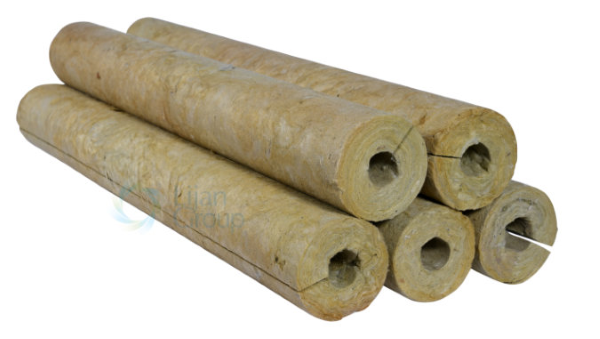
Lijan Group works with all types of insulation material including Rockwool, calcium silicate, and ceramic fibre using local and internationally certified materials.
How to Select the Right Insulation System
Selecting the correct insulation system for any application involves a structured assessment of several variables:
Operating temperature. The insulation material must be rated for the operating temperature of the surface it is applied to, with a margin for process excursions.
Ambient conditions. In the UAE, high ambient temperatures and humidity cycles affect both material performance and the risk of condensation on cold systems. Insulation design must account for local climate conditions.
Mechanical exposure. Pipework in high-traffic areas requires more robust cladding. Equipment subject to vibration needs materials with appropriate flexibility or mechanical tolerance.
Fire rating requirements. In offshore, marine, and many onshore industrial applications, fire-rated insulation is a regulatory requirement, not an option. The fire rating must match the application's classification.
Personnel protection requirements. Any surface above safe touch temperature in a personnel access zone requires protective insulation regardless of the thermal performance requirement.
Acoustic requirements. Where noise control is a factor, acoustic performance must be assessed alongside thermal performance.
Maintenance access. For equipment requiring regular inspection or maintenance, removable insulation jackets are the appropriate solution rather than fixed systems that must be cut and replaced.
Installation Quality: Why It Matters As Much As Material Selection
The best insulation material, incorrectly installed, will underperform. Installation quality determines whether the system achieves its design thermal performance, whether moisture can penetrate at joints and terminations, whether cladding remains secure under mechanical stress, and whether the system will last its intended service life.
Key installation quality factors include:
- Correct material thickness as per the engineering design specification
- Proper joint staggering to eliminate thermal bridging
- Correct application of vapour barriers on cold systems
- Secure mechanical fixing of cladding without gaps at seams
- Proper weatherproofing at terminations, supports, and penetrations
- Inspection and sign-off against the design specification before commissioning
Lijan Group offers a full turnkey solution from concept through design, engineering, detailed drawings, fabrication, installation, and commissioning, ensuring that every stage of the process is executed to the required standard.

Why Choosing the Right Contractor Matters
Industrial facilities in Dubai operate under relentless pressure: extreme ambient temperatures, aggressive humidity cycles, high-stakes process environments, and energy costs that make operational efficiency a financial necessity. The insulation and cladding on your pipework, vessels, and building envelope is not a finishing detail. It is a core engineering decision, and the company you choose to execute it will determine how well your facility performs for years to come.
When evaluating insulation and cladding companies in Dubai, the criteria that matter most are:
Sector experience. A contractor with deep experience in your specific sector understands the regulatory requirements, material standards, and operational constraints that apply. General building contractors and specialist industrial insulators are not equivalent.
Material range. A contractor limited to a narrow range of materials will default to what they know rather than what your application requires. The right contractor works across the full spectrum of insulation materials and cladding systems.
Engineering capability. For complex projects, you need a contractor who can contribute at the design and engineering stage, not just execute a specification handed to them.
EHS standards. In oil and gas, marine, and power sector environments, EHS compliance is non-negotiable. Verify that any contractor you engage operates to internationally recognised health, safety, and environmental standards.
Turnkey capability. A contractor who can manage procurement, fabrication, installation, and commissioning under a single contract reduces interface risk and project complexity.
Established in 2004, Lijan Group is headquartered in Dubai with branches in Fujairah, Sharjah, and India, offering complete insulation services across power and desalination plants, refineries and petrochemical plants, offshore and onshore oil rig platforms, and industrial plants including cement, steel, fertiliser, and chemical facilities.
Frequently Asked Questions
What is the difference between hot insulation and cold insulation?
Hot insulation is applied to surfaces operating above ambient temperature to retain heat and protect personnel. Cold insulation is applied to below-ambient systems to prevent heat gain and condensation. Both require different materials, vapour management strategies, and cladding systems. They should never be confused or interchanged.
What is A60 fire-rated insulation and when is it required?
A60 classification means an insulation system maintains structural and thermal integrity for 60 minutes in a standard fire test. It is mandatory on marine vessels, offshore platforms, jack-up rigs, and many onshore facilities with fire safety zone classifications. It is a regulatory requirement, not a performance enhancement option.
What is the difference between insulation and cladding?
Insulation is the thermally resistant material applied to the surface. Cladding is the protective outer jacket that shields the insulation from mechanical damage, moisture, UV, and environmental exposure. Both are required for a complete, durable system. Insulation without cladding degrades rapidly in industrial environments.
How do I know what thickness of insulation I need?
Insulation thickness is determined by an engineering calculation that accounts for the operating temperature, the ambient temperature, the required surface temperature limit (for personnel protection), the acceptable heat loss, and the material's thermal conductivity. This calculation should be performed by a qualified engineer, not estimated. Undersized insulation will not achieve the required performance.
Can insulation be applied to existing equipment without a shutdown?
In some cases, yes. Removable insulation jackets can be fitted to valves and flanges during normal operations. For fixed systems on active pipework and vessels, hot work procedures and safety assessments are required. Lijan Group's engineering team can advise on the appropriate approach for any live plant situation.